by Tim Blömeke
Working with people from a wide range of backgrounds is one of my favorite perks of of being a technical diving instructor. The training tends to be intense, information flows both ways, and I rarely walk away from a course without having learned something interesting and worth knowing about how the world works from the perspective of my students. Here’s one example related to the psychology of stress.
Stress is an important topic in technical diving courses. I usually present it in terms of beneficial and harmful stress: In a nutshell, beneficial stress is low level and can improve performance. When stress increases, it can become harmful by causing hyperfocus on the stressor, at the expense of other potential hazards. Stress can ultimately result in the fight/flight response, which is very counterproductive in a diving scenario.
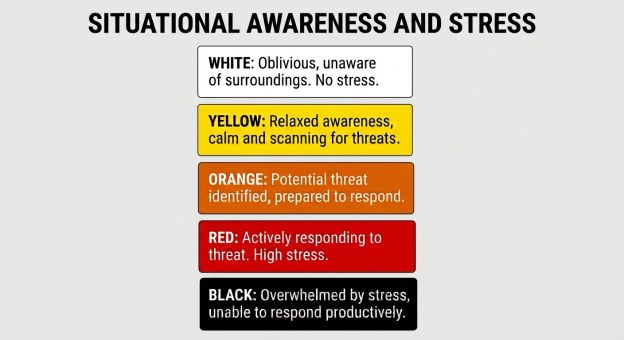
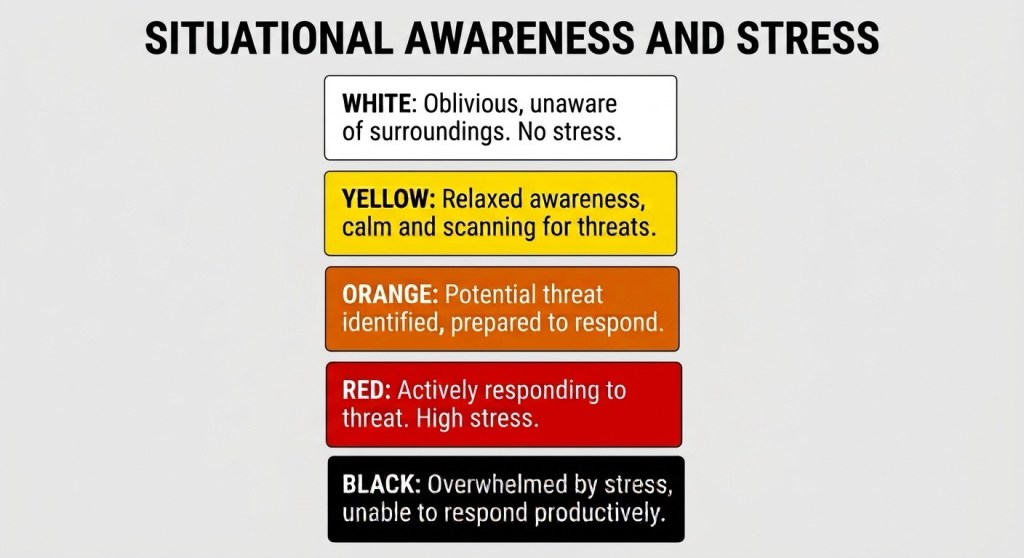
I recently had the opportunity to work with a diver who had undergone security training as part of his professional education. He taught me a system that assesses situational awareness and stress in a simple color code. I find it very descriptive and useful for categorizing the mind states of divers.
Interpretation in the context of diving
White would be a diver whose mind is occupied by something non-threatening and who isn’t paying attention. A good example would be a photographer looking into their camera lens. Maybe some narcosis is involved. This diver isn’t in imminent danger, but also not contributing to anyone’s safety, including their own.
Yellow is the state we want to be in for most of a dive. We’re aware of our depth, gas, runtime, decompression status, and team. We know that everyone is well, and we’re actively taking in our surroundings without having to focus on a single aspect.
Orange is the state we should be in when something specific is going on, or a change in circumstances occurs – for example when observing a teammate performing a gas switch or deploying a DSMB, or when a dive gets thumbed due to a low-on-gas situation. It is also the state an instructor is in for most of a training dive, when a good chunk of their attention is absorbed by watching over students (specific hazards).
Red kicks in when an unplanned event occurs and requires a response. Examples would be struggling with a new skill, loss of buoyancy control (self or teammate/student), overexertion, team separation, or an out-of-gas situation. In these types of situation, stress levels are up. The diver’s attention is absorbed by dealing with the issue at hand, and awareness of other aspects of the surroundings is significantly reduced. A second problem occurring at the same time would likely go unchecked.
Black is a panicked or otherwise unresponsive diver who is no longer able to effectively manage their own situation, much less assist anyone else.
Application and conclusions
The system has a few implications for good diving practices. During training, students are learning to deal with new situations, and the instructor is observing them, ready to deal with any problem – condition orange for both. Intervention may be necessary occasionally (red). This is unavoidable during training, but it’s not where we want to be in the long run.
Yellow – the safest state – is only attainable when all of the background tasks we’re performing at any given time (buoyancy control, trim, finning, gas management etc.) have become effortless routine. Building routine takes time and cannot be achieved while still actively learning new skills. It requires experience dives.
During these dives, divers should be careful to avoid becoming a little too happy with their newly acquired abilities and drift off into condition white. The old adage, “every dive is a practice dive,” can be interpreted to mean that even when nothing special is going on, we still need to practice being in the right mind state.
An interesting corollary applies to instructors. Instructors who only dive when teaching spend most of their time underwater at elevated stress levels, constantly scanning students who are in the process of developing new skills. This can become a habit. In order to practice relaxed awareness, it is therefore important for instructors to dive outside of work.
 Tim Blömeke