At last year’s RF4, Dr. David Doolette dropped a few remarks about how Bühlmann with gradient factors might not be the be-all and end-all of decompression models when it comes to very deep and long technical and cave dives. He encouraged divers to look into the US Navy’s Thalmann algorithm.
Here’s my piece for GUE’s InDepth magazine explaining what this is all about – an interesting variation on traditional Haldanean models that has been around since the 1980s, more or less ignored by the civilian dive community. Buckle up for some theory!
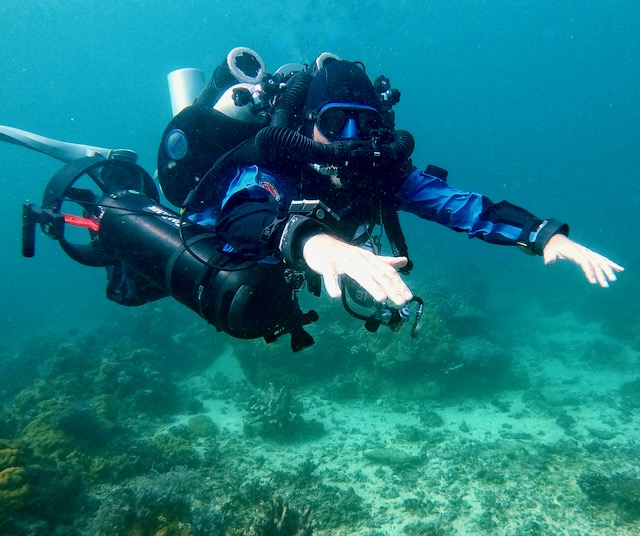
Puerto Galera, Philippines, February 2024 In March last year, I trained on the Fathom Mk III CCR under Kelvin Davidson in Mexico. Since then, I’ve had opportunity to use it in different environments and circumstances, both for my own enjoyment and in my role as a dive professional. I recently completed my first 100 hours on the unit, and I thought this might be a good milestone to revisit my experiences.
Photo credit: Katia Chen
Background
I’m an open circuit trimix instructor and tech dive guide working mainly out of Puerto Galera, Philippines. I’ve been a rebreather diver since 2017, and the Fathom is my second unit.
Once bitten, twice shy: Having experienced a number of reliability issues with the electronics of my first rebreather, I wanted to switch to a manual unit. At the time, I only knew of two – KISS and the now-discontinued Pelagian – and I spent some time looking at my options for either.
Why the Fathom?
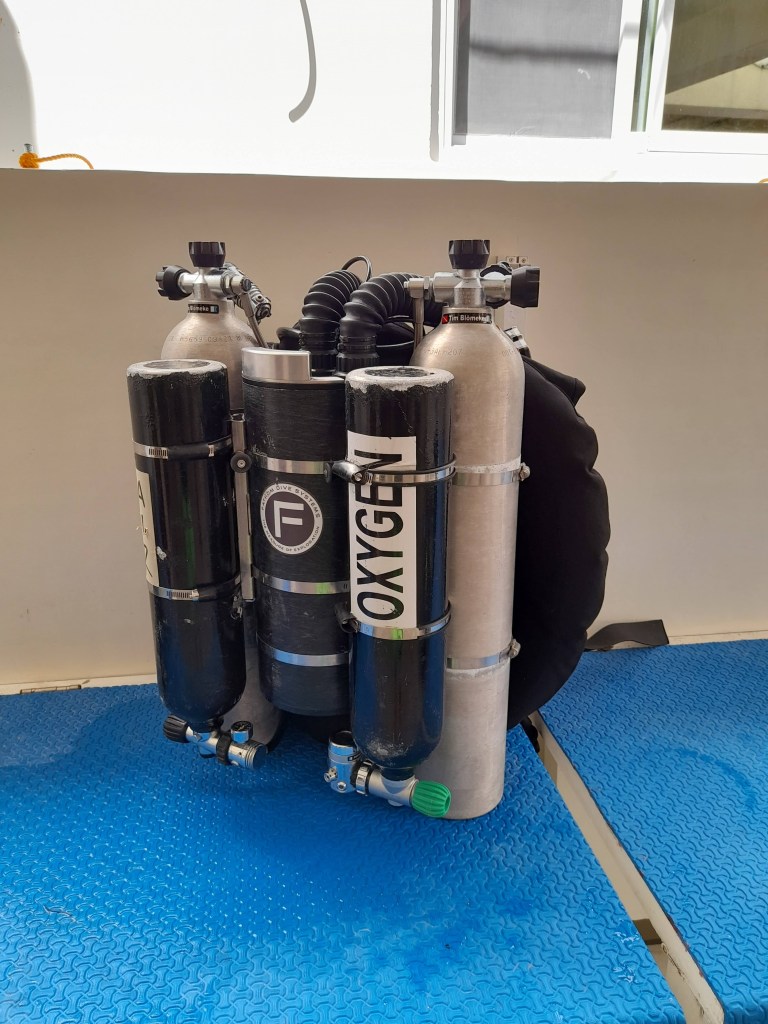
Then I stumbled across a rebreather I hadn’t heard of before, the Fathom. Going by the specs, it ticked all of my boxes. and the design notes by Fathom Dive Systems CEO Charlie Roberson spoke to me in a loud and clear voice: Robust and minimalistic, with fully potted (sealed) wiring, coax sensor connectors, adjustable constant mass flow injection of O2, passive Shearwater electronics, back-mounted counterlungs, and an option for on-board bailout.
As chance would have it, I already knew my instructor: Kelvin Davidson, owner of Third Dimension Diving in Tulum, Mexico, whose facilities my partner Katia and I had used twice on cave diving trips. I contacted him to inquire about the unit and a training course.
Although the price tag is considerable and instruction is currently available only on the far side of the planet, I was sold. I took a big leap of faith and broke the piggy bank. My partner and I purchased a unit each and booked a trip to Tulum for training.
Training
Though technically a crossover class, training on the Fathom ended up being more of a re-training in rebreather diving in general. Although I had accumulated about 120 hours on my prior unit, I hadn’t dived on closed circuit in over three years and had gotten quite rusty. There are also considerable differences in how the two units handle, as well as in the overall concepts and methods of using a rebreather as taught by Kelvin (who was himself involved in the Fathom’s development) compared to my prior training.
In a word, I had my hands full for a while, but it was more than worth it in the end: I was doing proper cave dives on my new CCR. I’m deeply grateful to Kelvin and the Third Dimension team for their support and the lessons learned, and I can’t recommend these guys highly enough.
Change of scenery
For the first 40-odd hours, I had dived in cenotes, caverns, and caves, to a maximum depth of no more than 30 meters. After a three-month stint in Europe with virtually no diving, my next task was to learn how to use the Fathom in a different environment – my home turf, the tropical seas of the Philippines, with their occasionally strong currents and greater depths.
I began with a series of shallower tryout dives to fine-tune the configuration and get used to blue-water ascents before gradually extending my range, adding a scooter and more bailouts. At this point, I would like to give a shoutout to my friend and JJ CCR virtuoso Karl Hurwood, whose advice and encouragement have been very valuable.
Handling and operation
Despite its being a manual unit, diving a Fathom requires surprisingly little manual intervention once you get the hang of it. At depth, the adjustable constant mass flow design for oxygen injection (fixed-IP first first stage and needle valve) works remarkably well. I rarely have to touch the oxygen MAV at all, except during ascent and deco, when everybody has to do that anyway, including eCCR divers.
Since I opted for the version without an ADV (another once-bitten-twice-shy situation here), I’m a little busier during descent than my JJ-using buddies. However, managing descents has become natural pretty fast. It’s much like driving a stick shift vs. automatic transmission – yes, it takes a little bit of extra practice, but ultimately, the outcome is very similar.
While I wear a drysuit for bigger (by my standards) dives, the unit is lightweight enough to be dived comfortably even in a thin wetsuit when paired with aluminum cylinders. The buoyancy characteristics and balance of my configuration feel similar to those of an AL80 set of doubles.
The work of breathing is very low, comparable to open circuit. The on-board bailout configuration with manifolded dual diluent tanks (“GUE configuration”) eliminates the bottom bailout stage, which feels very clean and leaves the front of the body unencumbered.
These days (as of February 2024), I am making 90-minute trimix dives in the 60+ meter range on a regular basis and have started using my unit for work. I dive it every chance I get outside of work as well (i.e., when not teaching open circuit) and have been averaging about 15 hours per month lately.
Summary
I can’t describe the Fathom as anything but a workhorse, in the best sense of the word. It behaves in very predictable ways and is comfortable and intuitive to dive. The build quality is stellar, and there doesn’t appear to be much about the unit that can actually break down. Aside from the canister, head (fully sealed, no service required), and counterlungs, all other parts are generic and can be sourced on the open market. This reduces dependence on manufacturer service to a minimum – not a concern for everybody, but a pretty big deal where I dive.
I’ve had zero issues that I didn’t create for myself. Should any problems materialize, I’m confident that I can deal with them with the tools and tech skills that I have (which include regulator service but not electronics). I look forward to many more hours of hassle-free diving and would unconditionally recommend the Fathom as a rebreather for remote locations.
On a final, general note, I believe that the introduction of this unit marks the point where manual CCR technology has become fully mature. While eCCRs remain an area of active research and development, and there is some competition in the sidemount CCR market as well, I find it difficult to imagine anyone spending time and money on an attempt to improve on the Fathom, much less succeed at it. If a manual backmount CCR is what you want, then Fathom is the way to go.
My experience so far in numbers Time on the unit: 109 h Deepest dive: 75 m Longest dive: 190 min Times I had to bail out: 0 Electronics problems: 0 Mechanical problems: 0 Lessons learned: yes Sharks seen: lots
UPDATE(September 2025) Revisiting this post a year and a half and well over a hundred hours down the road (250+), I stand by pretty much everything said above. The Mk3 continues to perform exceptionally well – so well in fact that I recently took the plunge and became an instructor on the unit.
In terms of problems, I had one issue with the handset, which was promptly taken care of by Shearwater. For completeness sake, I’ve also had to replace an O-ring.
As regards range, my biggest dive so far was in the context of a project to dive the USS Ommaney Bay, a WW2 escort carrier at the bottom of the Sulu Sea, at 115 meters of depth. No upgrades to the unit were required for these dives; the Fathom handles them in the out-of-the-box configuration.
TL;DR: If you’re looking for a rebreather that is up to the demands of big dives dives in remote locations and just keeps going, you couldn’t wish for anything better than the Mk3. Please feel free to reach out for questions regarding the unit or inquiries about training,
Carbon dioxide buildup is a common contributor to diving emergencies. In this first part of a three-part series for Alert Diver (EU), I’m sharing a personal experience and take a brief look at the metabolism of carbon dioxide in the human body.
Part two will focus on how the carbon dioxide metabolism is affected by diving, and what makes hypercapnia – excess CO2 in the bloodstream – so dangerous.
Part three will focus on countermeasures – skills and procedures to keep our CO2 load in check.
The high price and limited availability of helium have made rebreathers pretty much a must have piece of equipment for frequent trimix divers. However, just because you’re saving a lot on gas doesn’t mean rebreather diving is cheap – those gas savings come with a price tag, and whether that price tag is worth it very much depends on how much you actually dive.
Inspired by a talk by Mauritius Valente Bell at RF4 in Malta, my latest piece for Alert Diver deals with diving in mixed teams of open and closed-circuit divers.
While Mauritius’ presentation focused mainly on the perspective of rebreather divers, my piece is addressed to an audience of experienced recreational and open-circuit technical divers. Check it out to learn how the dark side ticks.
My latest piece for Global Underwater Explorers magazine InDepth is an interview with Mike Winters, a US military veteran with a habit of volunteering for hyperbaric chamber experiments. As a consequence of this habit, he has more experience with, umm, let’s call it physiologically challenging breathing gas compositions than pretty much anybody else. He is also a great storyteller.
Special thanks are owed to my friend Dr. Rachel Lance for the introduction.
A reader who is himself a diver and M.D. contacted me with a question about my articles on gas planning and RMV calculation in Alert Diver. I think his question is very interesting and addresses an aspect of the subject that I didn’t cover in the articles themselves. Here is our exchange.
Q: Dear Tim Thank you for your article ‘Let’s talk about gas planning’ in [Alert Diver]; very thought provoking in terms of safety I am an anaesthetist and Intensive Care Doctor and also enjoy recreational diving I wanted to ask about the RMV and the value of 15 litres. The average tidal volume (volume of each breath) ia about 70 mls/kg and the breathing rate is about 12-15 breaths. am 70kgs so my RMV would be 500mls per breath x12-15= 6-7.5 litres. For a 90kg diver this would be 630×12-15=7.5-9.5 litres. I do of course appreciate the additional factor of stress that you mention and I am purely referring to RMV I stand to be corrected of course I look forward to reading the other articles on your website Thank you Kind regards, Michael
A: Hi Michael, thank you for your kind email, it’s always nice to get feedback on my dive-related ramblings. As to your question, is the example calculation you provided based on RMV at rest, or even under narcosis? I’m asking because 7.5 l/min would be very low even for a small diver, and I don’t think I’ve seen anyone who breathes a 6, except some kids maybe. (When breathing air, our lungs take up about 5% of the inhaled volume in oxygen. With an RMV of 6 l/min, that would be 0.3 l/min of oxygen available to cover metabolic needs. IIRC that’s too little for most people to live on, at least while diving.) The typical range for somewhat experienced, adult divers (I’d guess it covers 90% of the population) is between 10 and 18 l/min. Large men sometimes use more (north of 20). Then again, I personally know a large middle-aged guy who breathes less than 10. Long story short, in practice you’ll find a lot of variance around any value derived from estimates based on physical characteristics. I suppose this is due to there being a large number of extraneous factors in diving compared with the controlled environment of a surgical theater, and all of these factors work to increase RMV compared with a resting state. So if you want to know your RMV, there’s no way around tracking your gas use and doing the math post-dive. A how-to is linked in the Alert Diver article. On the plus side, there is surprisingly little variance for a given individual between dives – maybe a liter in either direction on a particularly good or bad day, holding everything else constant (gear configuration, workload, environment). So if you make it a habit to calculate your RMV after every dive, you’ll have a pretty dependable value after only a few iterations. Hope this helps, thanks again for the question, and please feel free to follow up if there’s anything else I can do for you. All the best and safe diving, Tim
Caffeine has played a key role in the creation of this article. If you like what you read (or feel that it needs more caffeine), please consider adding fuel to the fire: https://bmc.link/timblmk
I had the pleasure and the honor to cover RF4 for DAN Europe last month. It was an amazing experience meeting the Who’s Who of technical diving, hyperbaric science, and diving technology. I certainly learned a lot, met some really cool people who do great things, and took home a whole list of ideas for new articles.
Here are three blog posts I wrote to summarize what went on on each of the three main days of the conference.
Thanks are due to Michael Menduno and his team for their fantastic work organizing the event, and to DAN Europe for putting me in charge of reporting. Stay safe and happy reading!


 Tim Blömeke